Quick answer
Before a school open house, choose a few things your family wants to learn, check the event details, and invite your child to help make the visit plan. During the visit, notice how adults welcome families, how students use the space, and whether you can get clear answers about learning, support, safety, and getting to school. Afterward, talk it over together and verify any enrollment details directly with the school.
An open house can help you get a feel for a school, but it is only one piece of the decision. The Ohio Department of Education and Workforce recommends combining school visits and conversations with educators and families with information such as Ohio School Report Cards. ([education.ohio.gov](https://education.ohio.gov/Topics/Data/Report-Card-Resources/Traditional-Report-Cards?utm_source=openai))
School open house checklist for parents
### Before you go
• **Check the event details.** Confirm the date, start and end times, entrance, parking or transit options, and whether children are welcome. Ask if you need to register or bring identification.
• **Find out what the event includes.** Some open houses offer classroom visits or a building tour; others may focus on meeting staff. Ask whether there will be time to talk with a teacher, office staff, or enrollment team.
• **Pick three priorities.** For example: how reading is taught, how families get updates, and how students travel to and from school. A short list helps you focus in a busy event.
• **Talk with your child.** Explain what will happen and ask what they are curious or worried about. Younger children may want to see the playground or classroom. Older children may want to ask about clubs, electives, or making friends.
• **Plan access and language support.** If you need an interpreter, a communication aid, or another access arrangement, contact the school beforehand and ask what is available. The U.S. Department of Justice and Department of Education explain that public schools have effective-communication responsibilities at events such as open houses. ([archive.ada.gov](https://archive.ada.gov/doe_doj_eff_comm/doe_doj_eff_comm_faqs.htm?utm_source=openai))
• **Bring a simple way to take notes.** Use a phone or paper to record answers and follow-up tasks. Ask before taking photos, especially if other students may appear.
### During the visit
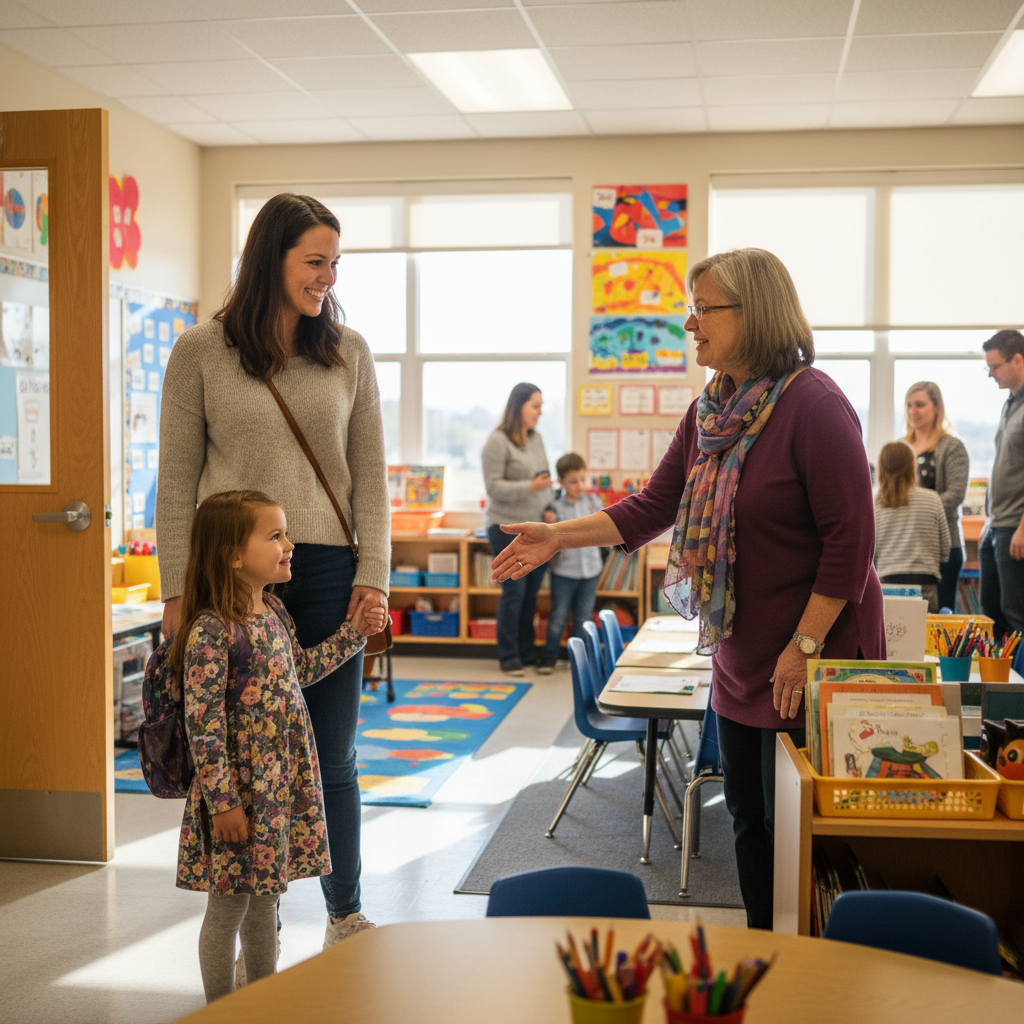
• **Notice the welcome.** Is it clear where families should go? Do staff explain how to ask for help? Do you see information in languages families in the community use?
• **Look at everyday spaces.** If they are part of the visit, notice classrooms, hallways, bathrooms, cafeteria, library, playground, and entrances. Think about whether your child could find their way around and feel comfortable.
• **Listen for how learning works.** Ask what a typical day looks like for your child’s grade. Notice how staff describe reading, math, hands-on learning, and ways students can ask for help.
• **Ask your child what they notice.** Use open questions such as, “What looks interesting?” or “What would you like to know more about?” There is no need to judge the school by one room or one interaction.
• **Notice how the school talks about belonging.** Ask how staff help new students settle in, address bullying or conflict, and connect students with clubs or other activities.
• **Take note of practical details.** Write down school hours, arrival and dismissal routines, meals, uniforms or dress expectations, after-school care, and transportation questions. These details can affect a family’s daily routine.
Questions to ask a school or provider
You may not have time to ask everything at the event. Choose the questions that matter most, then contact the school afterward for anything left unanswered.
### Learning and support
• What does a typical day look like for this grade?
• How do teachers share progress and concerns with families?
• How can a student get extra help with a lesson or a chance to stretch their learning?
• What languages are family updates available in, and how can I request an interpreter?
• Who should I contact with a question after the open house?
### Belonging, safety, and communication
• How do new students get help learning routines and meeting classmates?
• How are concerns about bullying, conflict, or student well-being reported and followed up?
• What are the school’s visitor check-in and emergency communication procedures?
• What is the usual way the school contacts families—phone, email, text, app, or another method?
### Daily logistics and enrollment
• What are the start and dismissal times, and what transportation options are available?
• Are meals, before- or after-school care, or clubs available? What are the current rules, schedules, and costs, if any?
• What are the application or enrollment steps, and what are the current deadlines?
• Are there attendance-area, grade-level capacity, or other enrollment limits families should know about?
• If we are considering a different school option, where can we get the official details in writing?
Treat answers about dates, availability, eligibility, services, and costs as details to verify. School policies and program offerings can change, and the open house may not be the enrollment office.
Ohio-specific things to check
Ohio families have several school options, and the choices available to a child depend on the family’s situation and the school’s rules. The Ohio Department of Education and Workforce describes options including traditional public schools, community schools, private schools, and e-schools; the Ohio Statewide Family Engagement Center also offers a tool to help families explore school options. ([education.ohio.gov](https://education.ohio.gov/topics/ohio-education-options?utm_source=openai))
If you are considering **open enrollment** in another public district or another school building, do not assume every district has the same process. Ohio districts set their own procedures and timelines, and policies may address capacity and grade-level availability. Ask the district directly about its current policy, application steps, deadline, and transportation. The state notes that families may be responsible for transportation when a student attends an open-enrollment district outside the family’s district of residence; ask the district whether it can offer transportation in your case. ([education.ohio.gov](https://education.ohio.gov/Topics/Ohio-Education-Options/Open-Enrollment?utm_source=openai))
Use the Ohio School Report Cards as one source of information, not as a complete picture of what your child’s day will feel like. The state says report cards provide performance information and recommends visiting schools and talking with educators, parents, and students to learn more. ([education.ohio.gov](https://education.ohio.gov/Topics/Data/Report-Card-Resources/Traditional-Report-Cards?utm_source=openai))
After the open house
1. **Compare notes while the visit is fresh.** Ask your child what they liked, what felt confusing, and what they still want to know. Listen before sharing your own view.
2. **Separate observations from unanswered questions.** “A staff member explained the arrival routine” is an observation. “I still need to confirm bus eligibility” is a follow-up task.
3. **Check important facts directly.** Contact the enrollment office or the appropriate program staff for current dates, requirements, transportation details, and costs. Ask for links or written information when helpful.
4. **Compare what matters to your family.** Consider learning, belonging, communication, accessibility, daily travel, and the practical fit for your household—not just one rating or one impression.
5. **Make a next-step list.** You might schedule another visit, compare two options, or complete an application. A visit does not obligate you to enroll.
### Privacy reminder
An open house is for learning about the school and its processes. You do not need to carry or hand over confidential child records just to tour a building. Avoid sharing medical, disability, IEP, custody, discipline, or other sensitive records in a crowded event or through an informal conversation. If you later need to discuss private information, ask the school for the right staff contact and a secure way to communicate. Share only what is needed for the specific next step.
Frequently asked questions
### Should I bring my child to a school open house?
If the school allows it, bringing your child can help them picture the space and ask questions in their own words. Check the event details first, since some events may have limits or a format that is easier for adults. If your child cannot attend, you can bring home notes and ask whether the school offers another visit opportunity.
### What should I look for during the tour?
Look for clues about the daily experience: how visitors are welcomed, whether directions are clear, how adults speak about students, and what learning and shared spaces are like. Pair what you see with direct questions. A short visit cannot show every classroom or every student’s experience.
### What if I need an interpreter or an accessibility arrangement?
Contact the school before the event and explain what would help you participate. Ask who will confirm the arrangement and when to expect a response. For public schools, federal guidance describes duties to communicate effectively with people with disabilities at school events, including open houses. ([archive.ada.gov](https://archive.ada.gov/doe_doj_eff_comm/doe_doj_eff_comm_faqs.htm?utm_source=openai))
### Does attending an open house mean my child is enrolled?
No. A visit is not the same as enrollment or acceptance. Ask the school or district for its current application process, eligibility rules, capacity information, and deadlines. In Ohio, open-enrollment procedures and timelines vary by district, so confirm them directly. ([education.ohio.gov](https://education.ohio.gov/Topics/Ohio-Education-Options/Open-Enrollment?utm_source=openai))
Make your next step easier
The right questions can turn an open house from a quick walk-through into a useful family conversation. Use the **Onward Families navigator** to organize your priorities, compare school options, and keep track of what you still need to verify—without sharing confidential child records.