Quick answer
Compare the full trip, not just whether a bus is available. Ask who is responsible for each part of the journey, how long it takes door to door, what happens when plans change, and what the backup is when a ride falls through. Then check the current rules and route details directly with your school and district.
These **Ohio school transportation questions** can help you compare schools on a practical basis: Where is the stop? How will my child get there and home? Who can I contact if the bus is late? Is the service available for my child’s grade and school?
Start with your family’s real-life needs
Write down the details that shape your weekday: work and caregiving schedules, school start and end times, the safest walking path, access to a car, and whether siblings attend different schools. Consider weather, darkness, busy streets, mobility access, and after-school activities—not only a typical sunny morning.
For each school you are considering, map the trip from your door to the classroom and back. Include the walk to a stop, waiting time, transfers, pickup arrangements and the trip after school. A short ride can still be hard if the stop is far away or the return plan does not match your work hours.
Compare the main options
### 1. School bus
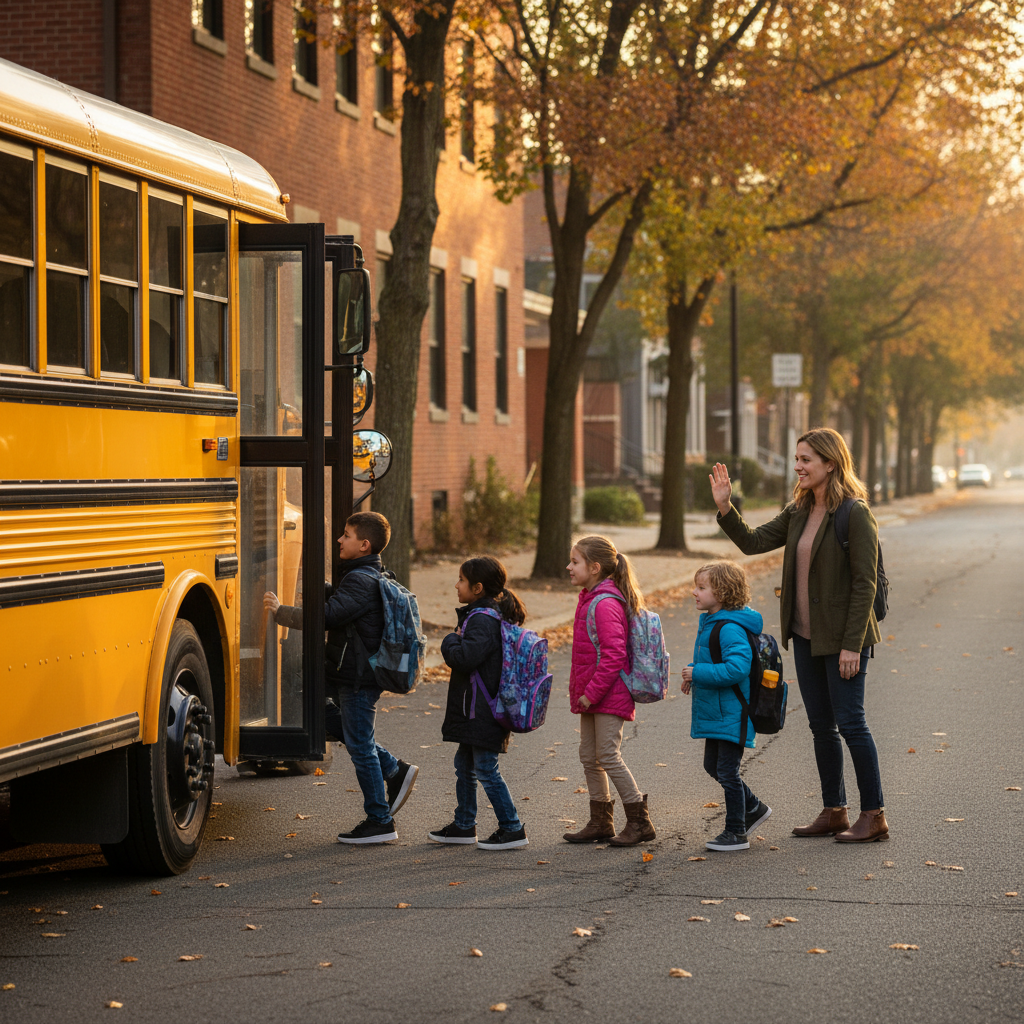
Ask whether bus service is offered to your address and grade, where the assigned stop is, and whether your child must cross a street. Get the expected pickup and drop-off window, the expected ride time, and the process for route or stop changes. Find out what the district does when a bus is delayed, a route changes, or a child misses the bus.
Visit the stop with your child before school starts, if possible. Look at visibility, traffic, lighting, sidewalks, waiting space and whether your child can safely reach the stop. NHTSA recommends evaluating the stop and the walking path, not treating the ride itself as the whole trip. Practice waiting safely and boarding. ([nhtsa.gov](https://www.nhtsa.gov/planning-safer-school-bus-stops-and-routes/planning-safety?utm_source=openai))
### 2. Family drop-off, pickup or carpool
This may offer more control, but consider traffic, parking, daily time, fuel, and who is authorized to pick up your child if you cannot. Ask the school about arrival and dismissal procedures, late-arrival rules, visitor checks, and how it handles a change in the pickup plan. If another caregiver drives, agree in advance on a backup and how you will communicate schedule changes.
### 3. Walking or biking
Walk the route at the time your child would travel. Check sidewalks, crossings, traffic speed, lighting, construction and safe places to wait. Ask the school whether it offers a walking school bus, crossing support, or bike parking—but confirm whether those services are available at your child’s school and on your route. A route that looks manageable for an adult may not be right for a young child to travel alone.
### 4. Public transit or another arranged ride
In some communities, families may consider public transit or a school-arranged option. Confirm who plans the route, whether an adult accompanies children, what transfers are required, how service disruptions are handled and whether there is a cost. Do not assume that a transit pass or ride is included with enrollment. For Ohio community and nonpublic school students in grades K–8, state law has specific conditions on district use of mass transit; ask the district and school how any proposed arrangement works. ([codes.ohio.gov](https://codes.ohio.gov/ohio-revised-code/section-3327.017?utm_source=openai))
### 5. School-specific or paid transportation
Some schools may offer a private shuttle, contracted transportation or other arrangement. Ask who operates it, which grades and neighborhoods it serves, whether fees apply, and what safety and supervision procedures are used. Get the current details in writing; availability and terms can change.
Ohio context: eligibility is not the same as a route guarantee
Ohio law generally requires city, local and exempted village school districts to transport resident pupils in grades K–8 who live more than two miles from their assigned public school. The law also addresses eligible community and nonpublic school students, but eligibility depends on the circumstances and statutory requirements. Exceptions and local policies matter, so do not assume that every child, school or address receives the same service. Confirm your situation with the district transportation office. ([codes.ohio.gov](https://codes.ohio.gov/ohio-revised-code/section-3327.01?utm_source=openai))
When a district determines that eligible transportation is impractical, Ohio law provides a process involving an offer of payment in lieu of transportation. Families can accept or reject the offer; if they reject it, they may request state mediation. Ask the district to explain the decision, the choices, and any relevant process or deadlines directly. Do not rely on an informal conversation alone. ([codes.ohio.gov](https://codes.ohio.gov/ohio-revised-code/section-3327.02?utm_source=openai))
For open enrollment, Ohio’s Department of Education and Workforce says the attending district’s transportation responsibility is limited in important ways, including transportation from a designated stop within the district under district policy. Ask both the resident and attending districts what, if anything, they can provide for your route. ([education.ohio.gov](https://education.ohio.gov/Topics/Ohio-Education-Options/Open-Enrollment/Open-Enrollment-FAQ?utm_source=openai))
Preschool is a separate question: Ohio law says a district operating a preschool program may provide transportation, and special-education transportation rules may apply in particular circumstances. Ask the preschool and district what service is available for your child rather than assuming K–8 rules apply. ([education.ohio.gov](https://education.ohio.gov/getattachment/Topics/Finance-and-Funding/School-Transportation/Transportation-Rules-and-Regulations/Pupil-Transportation-Operations-and-Safety-Manual-2025.pdf.aspx?lang=en-US&utm_source=openai))
If transportation is part of a child’s disability-related services, contact the IEP team or responsible school staff to discuss the arrangements and how they will meet the child’s needs. Ohio guidance describes transportation as a related service when included in an IEP, and state law addresses certain children with disabilities attending nonpublic schools. Share records only through the school’s approved, secure process when needed; do not send sensitive documents through an informal app or public message. ([education.ohio.gov](https://education.ohio.gov/Topics/Finance-and-Funding/School-Transportation/Transportation-as-a-Related-Service-Update?utm_source=openai))
Practical steps before you choose
1. **Ask early.** Contact the school and district before accepting a place or making a final choice, especially if the school is outside your neighborhood or district.
2. **Request the current route details.** Ask for the stop location, schedule window, expected ride time, change process and any fees. Routes may be finalized or revised after enrollment, so verify again before the first day.
3. **Test the trip.** Travel the route at school commute times. Note sidewalk gaps, crossings, transfers, waiting time and what happens if a caregiver is delayed.
4. **Compare backup plans.** Identify who can pick up your child, how the school confirms a change, and what to do if a bus or transit service is disrupted.
5. **Save key contacts.** Keep the transportation office, school office and after-school provider’s contact details somewhere caregivers can access.
6. **Recheck after changes.** Confirm arrangements after a move, school change, schedule adjustment or route update. Keep copies of written notices and agreements.
Questions to ask a school or transportation provider
• Is my child eligible for transportation from our address to this school? Who makes that determination?
• Where exactly is the stop, and does my child need to cross a street?
• What are the pickup and drop-off windows, and how long is the ride expected to take?
• Who supervises students at the stop, on the vehicle and at school arrival or dismissal?
• How will I be notified about delays, route changes or a missed pickup?
• What is the plan if my child is not met at drop-off or the usual caregiver is unavailable?
• Are there fees, eligibility conditions, forms or dates we should know about?
• If the school is outside our district, which district or school arranges and pays for transportation?
• If my child needs an accessible vehicle or other transportation support, who should I contact to discuss it privately?
• Can you provide the current transportation policy and this year’s procedures in writing?
Safety and privacy reminders
Practice the route and stop with your child. NHTSA advises children to wait well back from the curb, board only when the bus has stopped, and tell the driver if something falls near the bus rather than reaching for it. Review the school’s own safety instructions too. ([nhtsa.gov](https://www.nhtsa.gov/road-safety/school-bus-safety?utm_source=openai))
Keep questions about disability services, medical needs, custody or other sensitive matters private. Share only what the school needs, with the appropriate staff, through a secure channel. You do not need to post a child’s records or personal details in a community group to compare transportation choices.
Four frequently asked questions
### Does Ohio guarantee a bus for every child?
No. Ohio law sets transportation requirements for certain students, including K–8 pupils living more than two miles from their assigned public school, but eligibility, school type, exceptions and local policies affect the answer. Confirm your child’s situation with the district. ([codes.ohio.gov](https://codes.ohio.gov/ohio-revised-code/section-3327.01?utm_source=openai))
### What if the school says transportation is impractical?
Ask for the written explanation and the formal options. Ohio law provides a payment-in-lieu process and allows a parent who rejects an offer to request mediation through the state department. Ask the district to explain the steps and any timing that applies to your case. ([codes.ohio.gov](https://codes.ohio.gov/ohio-revised-code/section-3327.02?utm_source=openai))
### Does open enrollment mean the new district will pick my child up at home?
Not necessarily. Ohio’s guidance says transportation for open-enrollment students is tied to district policy and designated stops; transportation from outside the district is generally the parent’s responsibility. Check with both districts because individual arrangements may differ. ([education.ohio.gov](https://education.ohio.gov/Topics/Ohio-Education-Options/Open-Enrollment/Open-Enrollment-FAQ?utm_source=openai))
### What if my child needs transportation support related to a disability?
Contact the IEP team or school staff responsible for transportation and discuss what is needed for the child to access school. Ohio guidance identifies transportation as a related service when included in an IEP; the details should be handled directly and privately with the appropriate team. ([education.ohio.gov](https://education.ohio.gov/Topics/Finance-and-Funding/School-Transportation/Transportation-as-a-Related-Service-Update?utm_source=openai))
Make the school choice work for your family
A school’s transportation plan affects mornings, work schedules, attendance and a child’s sense of independence. Compare the whole journey alongside academics, care and community fit. For another way to organize your questions and explore school options, try the **Onward Families navigator**—then verify current transportation details directly with the school and district before deciding.